Stop Chasing Leads. Start Chasing Alignment.
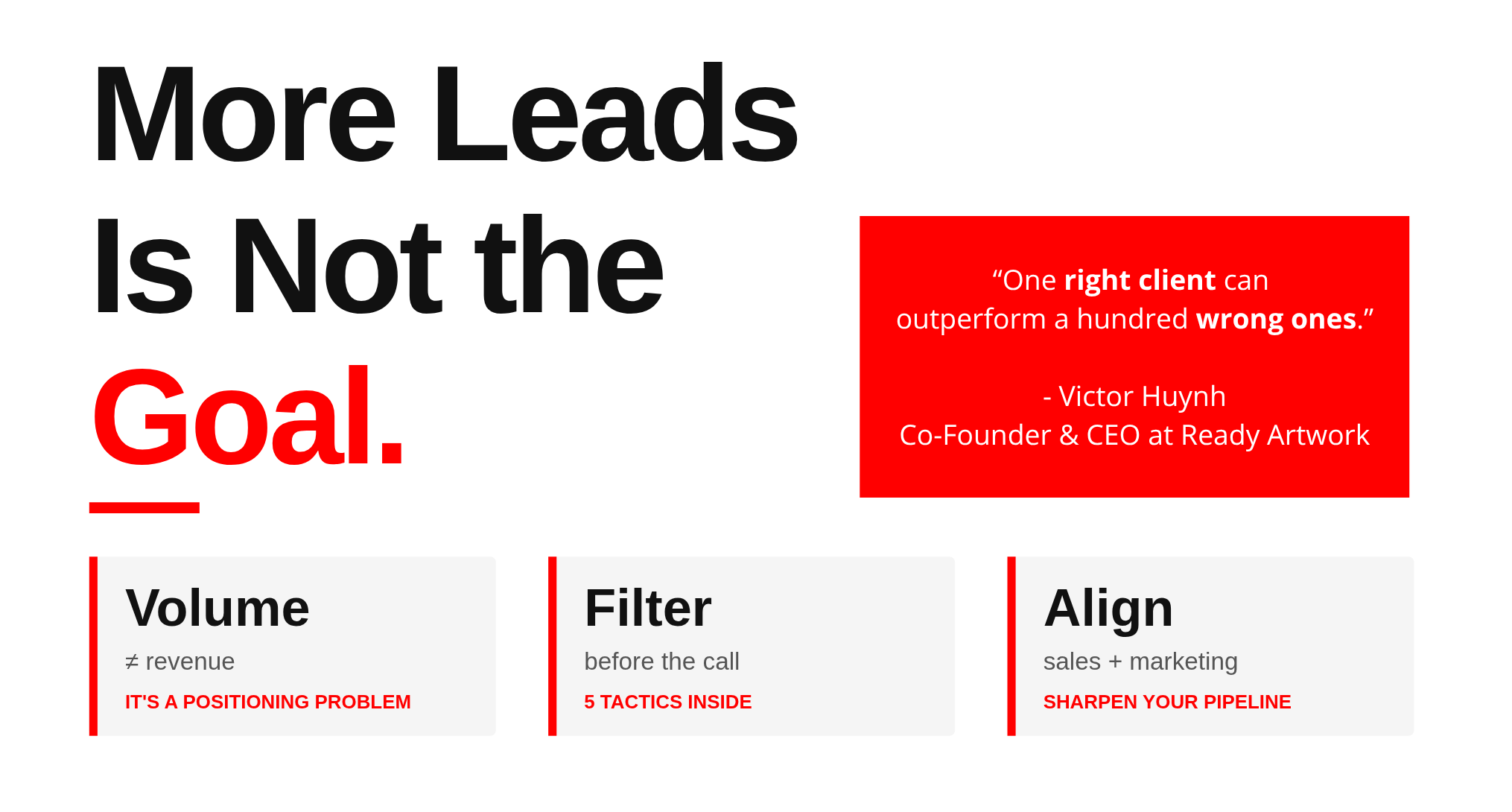
Here’s something most marketing advice gets completely backwards: more leads is not the goal.
I know that sounds wrong. But if you’re running a high-ticket B2B company — manufacturing, industrial services, specialized trades — you’ve probably lived this. The pipeline fills up. The sales team works overtime. And at the end of the month, the deals just… aren’t there. The leads sucked.
That’s not a sales problem. That’s a positioning problem. And it starts with confusing volume for alignment.
What’s the actual difference between a qualified lead and an unqualified one?
A qualified lead is someone who has the problem you solve, the budget to pay for it, and the authority to move forward. All three need to be true. Missing one means you’re in for a long, frustrating sales process that probably goes nowhere.
An unqualified lead is anyone else. They might be curious. They might even like what you do. But they’re not going to buy. And every hour your team spends with them is an hour not spent with someone who will.
In B2B, especially high-ticket B2B, the math is simple: one right client can outperform a hundred wrong ones. I’ve seen it happen. One aligned deal fills a manufacturer’s production schedule for the year. That’s the game.
Why broad messaging attracts the wrong people
Here’s the pattern I see over and over. A company writes their website and their marketing to appeal to “everyone.” They use phrases like “we work with businesses of all sizes” or “solutions for every industry.” They think this makes them more appealing.
What it actually does is attract the lowest common denominator. Buyers who are price-shopping. Buyers who don’t understand the value of what you do. Buyers who will grind you on every line item.
Your best clients — the ones who pay full price, refer you to others, and come back year after year — found you because they saw themselves in your messaging. They recognized their problem. They thought: “these people get it.”
That recognition doesn’t happen when your message tries to be everything to everyone.
5 tactics to start filtering leads before they hit your inbox
You don’t have to wait for a lead to get on a call before you find out they’re the wrong fit. Here are five things you can do now:
- State your minimum engagement clearly. If your projects start at $30,000, say so. Put it on your website. Put it in your marketing. The people who can’t afford it will disqualify themselves. The people who canwill respect you for being direct.
- Ask qualifying questions in your contact form. Company size, project timeline, budget range — these aren’t invasive. They’re professional. Add two or three and your intake improves immediately.
- Show your biggest, most complex case studies first. The wrong clients will see those and think ‘that’s not me.’ The right clients will see them and think ‘that’s exactly what I need.’
- Be specific about who you serve. Not “manufacturing companies” — be more specific. “Industrial HVAC manufacturers with three or more facilities.” “Distribution companies with regional fleets.” Specificity is a filter.
- Align your content to your buyer, not your category. Blog posts, videos, social content — it should all speak directly to the person you want to work with. If your content is generic, your leads will be too.
The feedback loop that sharpens your pipeline over time
Here’s the thing: you won’t get this right in week one. That’s okay. The companies that actually improve their lead quality over time treat marketing and sales as a feedback loop, not two separate departments.
Sales tells marketing which leads were frustrating to work with and why. Marketing adjusts the messaging, the content, the intake filters. The pipeline gets sharper. Repeat.
It takes a few months to really feel the difference. But when it clicks, it’s obvious. The calls get easier. The close rate goes up. The projects get better. And your team stops dreading Monday morning.
The right marketing doesn’t just attract everyone — it attracts the right ones. Better filtering equals a better pipeline.
FREEBIE: 7 Questions to Qualify a B2B Lead Before They Get on a Call
Use this in your contact form, your intake process, or your first outreach email. The goal isn’t to interrogate — it’s to make sure both sides are a real fit before anyone invests time.
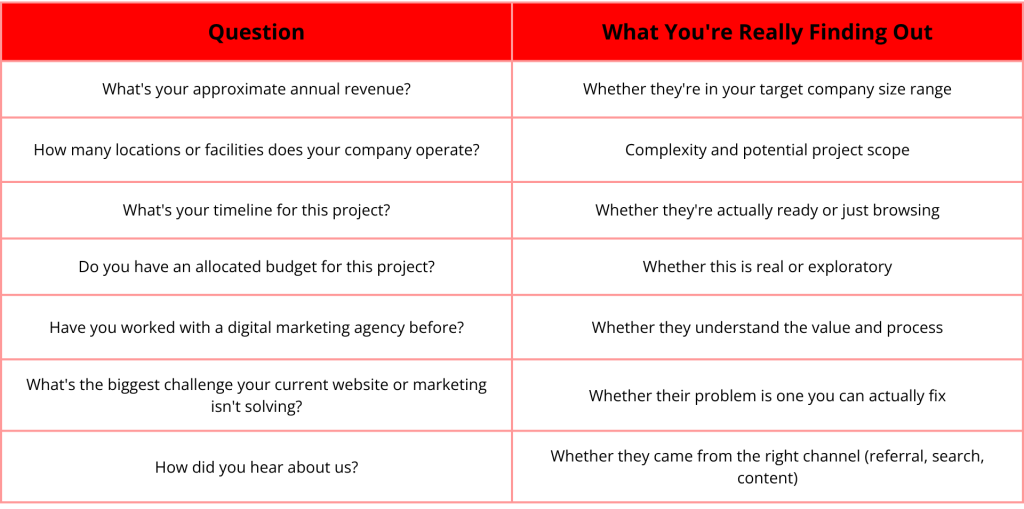
You don’t need all seven in your contact form. Pick three or four that tell you the most. The rest can come out in a short discovery call.