What Are the Four Types of B2B Markets?
Business‑to‑business (B2B) markets are foundational to the global economy, with organizational purchasing amounting to trillions of dollars annually across industries.
Understanding the distinct categories of B2B markets helps companies tailor marketing, sales strategies, and product positioning to the unique priorities and decision behaviors of each buyer group.
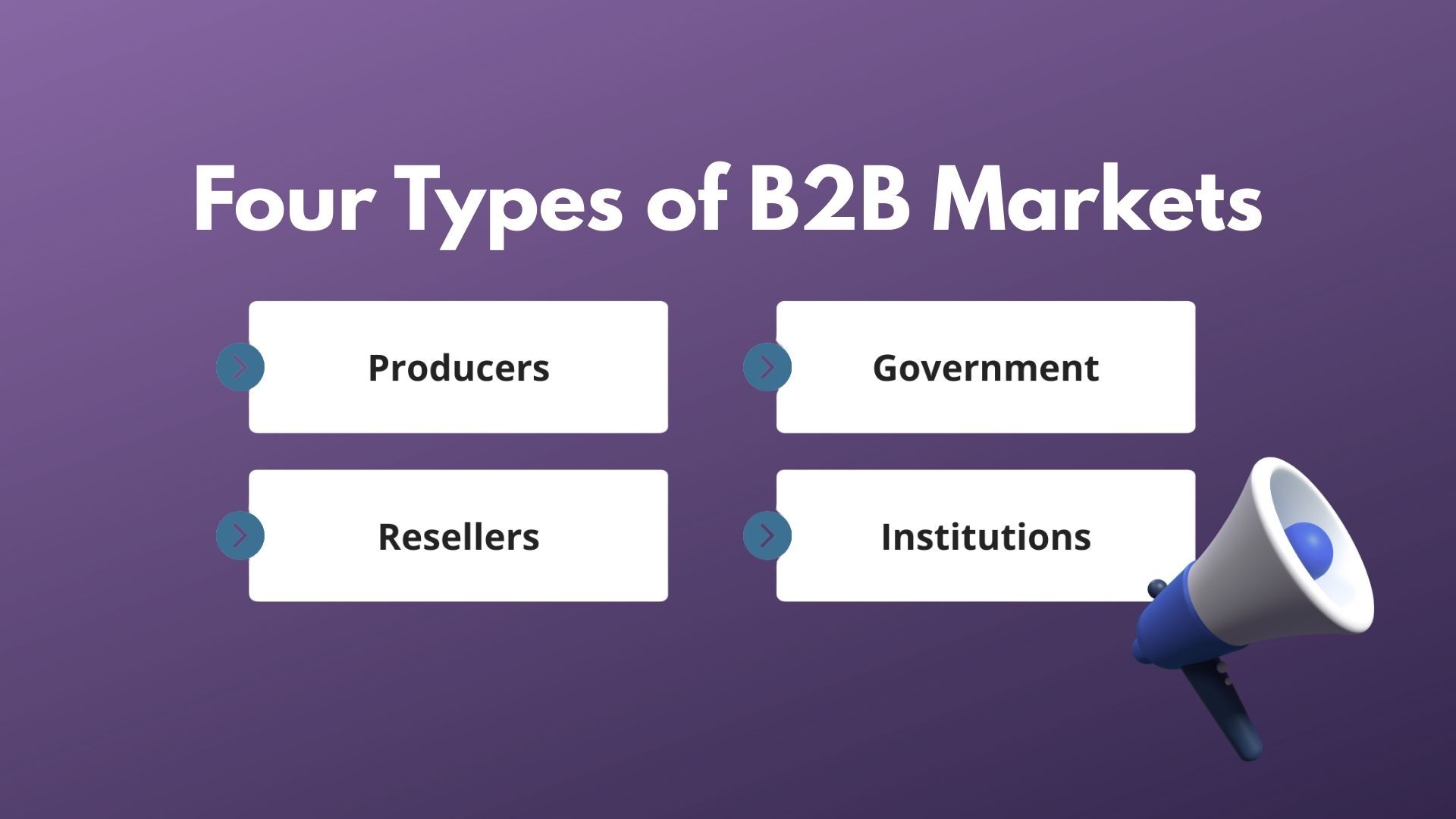
This article explains the four main types of B2B markets, producers, resellers, governments, and institutions, how they differ in buying behavior, and how sellers can more effectively engage each segment.
Key Takeaways:
Understanding the four types of B2B markets, producers, resellers, governments, and institutions, allows businesses to align their marketing, sales, and value propositions with how different organizations buy. Each market has distinct decision drivers, timelines, and priorities, and tailoring your approach to these differences is essential for building relevance, improving conversion rates, and sustaining long-term B2B growth.
B2B Market Type 1: Producers
Producer markets consist of firms that purchase goods and services to transform them into finished products or integrated solutions. These buyers include manufacturers, industrial service providers, and companies that require inputs to support their production processes or service delivery.
For example, a car manufacturer buys steel and electronic components to build vehicles, and a restaurant purchases ingredients to prepare meals. Each involves a B2B purchase that enables value creation downstream.
Producer markets tend to make highly rational, ROI‑focused decisions driven by efficiency, quality, and technical specifications, and their purchasing cycles are typically longer and more complex, given customization and volume requirements.
Marketing and sales efforts in this segment should emphasize cost‑saving potential, operational improvements, and product reliability certifications to align with their performance expectations.
B2B Market Type 2: Resellers
Reseller markets are made up of intermediaries that buy finished products from producers and sell them onward, often without significant modification. This category includes wholesalers, distributors, brokers, and retailers that add value through distribution networks, availability, and customer reach.
Decision drivers for resellers center on product demand, turnover velocity, pricing margins, and inventory management. Because resellers often operate with tighter margins and fast‑moving cycles, sellers should provide clear data on demand trends, competitive pricing structures, and logistical support that enables resellers to sell products profitably and reliably.
Efficient supply chain integration and responsive fulfillment support can significantly strengthen relationships within this market.
B2B Market Type 3: Governments
Government markets represent one of the largest segments of B2B procurement worldwide, encompassing federal, state, and municipal purchasing for a wide range of goods and services. Government buyers acquire everything from office supplies to infrastructure, healthcare equipment, defense systems, and digital solutions that support public services and civic operations.
Decision-making in this market is typically governed by formal request-for-proposal (RFP) processes, strict compliance requirements, certification standards, and fixed budget cycles.
Sales strategies must account for extensive documentation, public accountability, and longer procurement timelines, with an emphasis on compliance, value for money, and the ability to manage complex, large-scale contracts.
Specialized partners can make these complex requirements much more manageable. At Ready Artwork, we work with public-sector organizations in the Greater Los Angeles area to handle website design and development, SEO, UI/UX design, web accessibility (ADA), and digital paid advertising.
Our goal is to provide compliant, user-friendly digital experiences that help agencies meet accessibility standards, boost online engagement, and streamline how services are delivered to the public.
B2B Market Type 4: Institutions
Institutional markets include organizations such as educational institutions, hospitals, charities, and other mission‑oriented entities that purchase goods and services to support their operational goals rather than primarily to generate profit.
These buyers often balance budget constraints with mission impact, seeking solutions that help them achieve organizational objectives efficiently while maximizing value for stakeholders.
Purchasing decisions may involve multiple approvals from administrators, program directors, or board members, which can extend the sales cycle and require messaging that aligns with mission‑centric priorities.
Sellers targeting this segment should frame value in terms of operational impact, cost effectiveness, and alignment with broader goals, demonstrating how their offerings support service delivery or community outcomes.
Comparison Table: 4 B2B Market Types
| Market Type | Examples | Decision Priorities | Typical Sales Cycle | Effective Engagement Approaches |
| Producers | Manufacturers, industrial service providers | Efficiency, quality, customization | Long | Technical demos, cost/ROI modelling |
| Resellers | Wholesalers, distributors, retailers | Inventory velocity, margins | Medium | Demand data, competitive pricing |
| Governments | Federal, state, local agencies | Compliance, public accountability | Very Long | Certifications, RFP expertise |
| Institutions | Schools, hospitals, non-profits | Budget impact, mission alignment | Medium | Value/impact ROI narratives |
How to Segment & Target B2B Markets Effectively
Segmentation in B2B should start with firmographics, including industry, company size, and geographic location, which provide a baseline understanding of organizational needs and constraints.
Prioritize high‑value segments through customer tiering to allocate resources to the most promising opportunities.
Needs‑based segmentation, identifying specific operational pain points, enables tailored solutions that speak directly to the drivers of purchasing decisions within each B2B market type.
Combining segmentation with intent or behavioral data can improve targeting precision and increase conversion rates by ensuring messaging resonates with actual buyer priorities.
Common Mistakes in B2B Market Targeting
Generic, one‑size‑fits‑all messaging often fails in B2B contexts because different segments value different outcomes: producers focus on performance and integration, resellers on turnover and margins, governments on compliance and accountability, and institutions on mission value and cost‑effectiveness.
Ignoring segment‑specific requirements, such as regulatory or budgetary constraints in government and institutional buying, can derail otherwise promising engagements.
Additionally, overemphasizing product features rather than aligning benefits with the buyer’s business outcomes reduces perceived relevance and can slow decision-making.
Conclusion
Mastering the four key types of B2B markets, producers, resellers, governments, and institutions, enables sellers to customize value propositions, refine targeting, and design sales cycles that resonate with distinct buying behaviors.
By auditing your customer base against these segments and tailoring your marketing and sales strategies accordingly, you can unlock more consistent pipeline growth, higher conversion rates, and stronger buyer relationships across diverse organizational buyers.
Understanding these core categories and their unique characteristics is fundamental to effective B2B marketing and sales optimization in 2026 and beyond.